
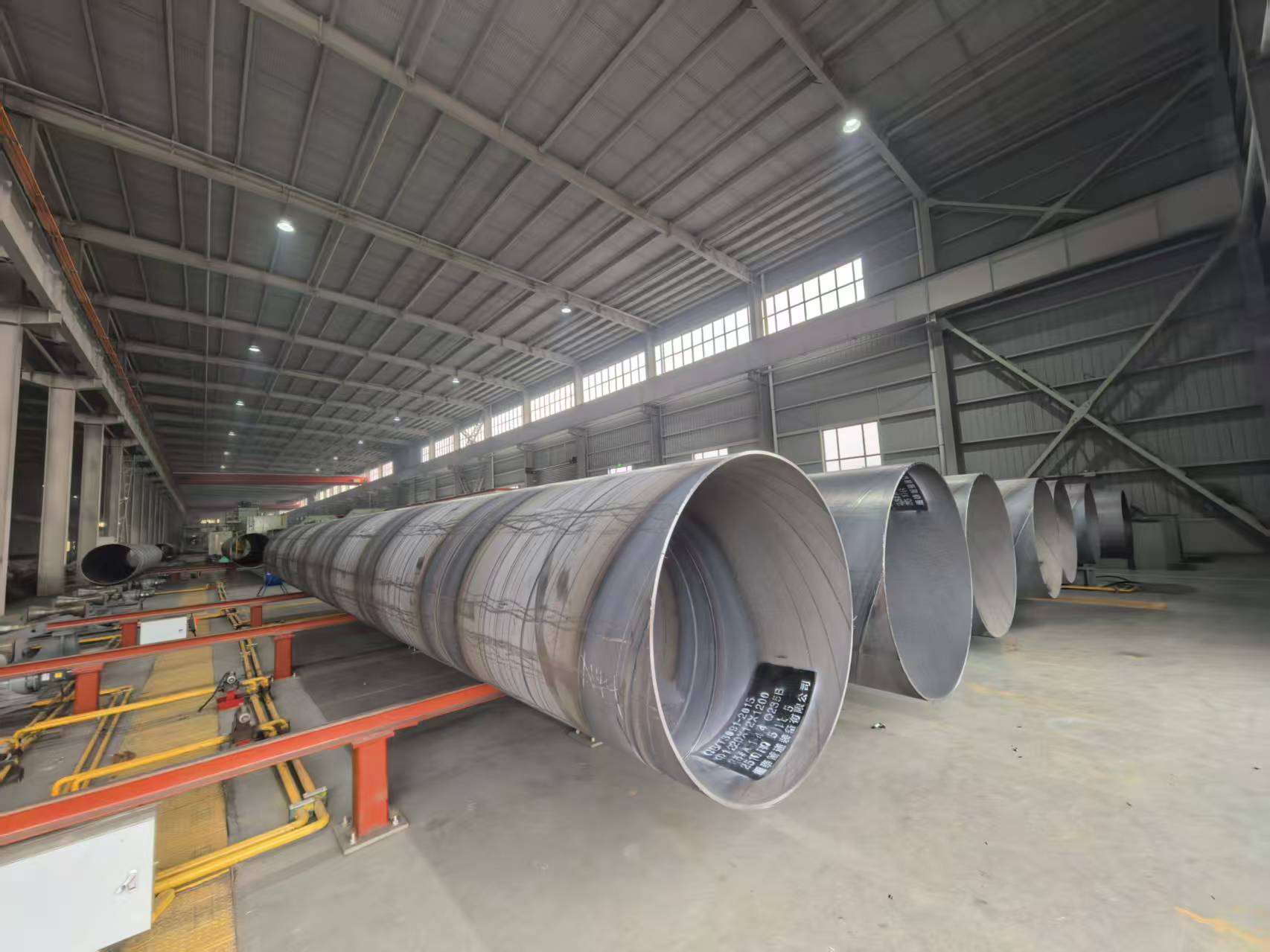
Spiral steel pipe, also known as spiral welded pipe, is manufactured by coiling low-carbon structural steel or low-alloy structural steel strip into a pipe blank at a certain spiral angle (forming angle), and then welding the seam. This process allows the production of large-diameter steel pipes using relatively narrow strip steel, offering unique process flexibility in terms of diameter specifications.
The products are widely used in long-distance oil and natural gas transmission pipelines, urban water supply and drainage, chemical, electric power, heating networks, building structures, and other fields.
Part 2: Product Advantages (Objective Statement)
Large-diameter production advantage
The spiral forming process allows the production of large-diameter steel pipes using strip steel of limited width. With the same width of base material, the forming angle can be adjusted to produce pipes of different diameters, providing high flexibility in product specification switching on the production line.
Weld strength
The force direction on the spiral weld forms a certain angle with the principal stress direction of the pipe body, resulting in lower equivalent stress on the weld. Under the same wall thickness conditions, the load-bearing capacity of spiral welded pipes is generally not lower than that of straight seam welded pipes of the same specification.
Comparison with straight seam welded pipes
Spiral welded pipes have a certain cost advantage in large-diameter production
In terms of weld length, spiral welded pipes have approximately 30% to 100% more weld length than straight seam pipes of the same length
In terms of production speed, spiral welded pipes are slightly slower than straight seam welded pipes
Based on the above differences, small-diameter welded pipes mostly use the straight seam process, while large-diameter welded pipes more often use the spiral process.
Part 3: Production Process and Specification Parameters
Forming process
Produced using the continuous forming and double-sided automatic submerged arc welding (SAWH) method. The welding process is subject to online continuous ultrasonic automatic flaw detection inspection, achieving 100% coverage; welds at key locations are also subject to X-ray inspection for confirmation.
Common specification range (for reference):
Outer diameter range: DN200 ~ DN2600 (single-step method)
Wall thickness range: 6.0mm ~ 25.4mm
Pipe length range: 6m ~ 20m, available in custom fixed lengths
Large-diameter group standard range: nominal outer diameter greater than 1422mm and less than or equal to 4064mm
Part 4: Applicable Standards and Common Materials (Verifiable)
Applicable standards (can be interfaced as required):
GB/T 9711: Steel pipes for petroleum and natural gas industry transportation
GB/T 3091: Welded steel pipes for low-pressure fluid transportation (including SAWH spiral submerged arc welded pipes)
SY/T 5037: Spiral submerged arc welded steel pipes for ordinary fluid transportation pipelines (industry standard)
SY/T 5040: Spiral submerged arc welded steel pipes for piles
API SPEC 5L: American Petroleum Institute line pipe standard (available in PSL1 and PSL2 grades)
Common material grades (partial list):
Carbon steel: Q235A, Q235B, Q345 (16Mn)
Line pipe steel: L245, L290, X42, X52, X60, X70, X80
Stainless steel series: configured according to working condition requirements
Part 5: Application Scenario Reference
Liquid transportation: water supply, drainage, sewage treatment, marine water conveyance
Gas transportation: gas, steam, liquefied petroleum gas, natural gas
Structural pipes: piling pipes, bridge structures, docks, roads, building structural supports