
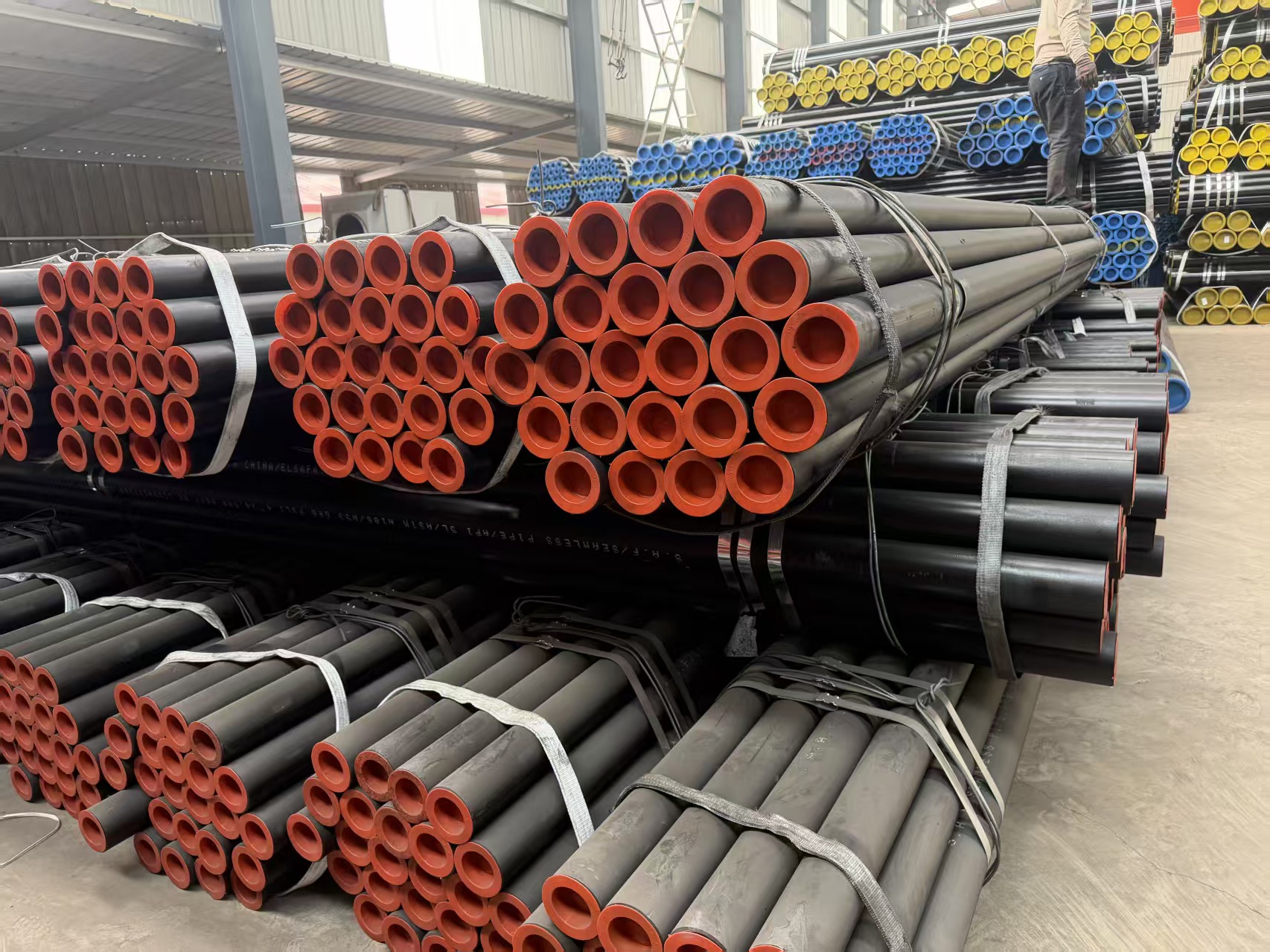
Seamless steel pipe refers to a steel pipe without any seam along its cross-sectional circumference. It is produced by piercing a solid round steel billet (tube blank) to form a hollow shell, which is then further processed through hot rolling, cold rolling, or cold drawing operations.
Since the pipe body has no weld seam, it offers good structural continuity and is suitable for working conditions that require certain levels of pressure-bearing capacity and material uniformity. The products are widely used in fields such as petroleum, natural gas, chemical, electric power, boilers, machinery manufacturing, shipbuilding, and building structures.
Part 2: Production Processes (Objective Statement)
The production methods for seamless steel pipes mainly include two categories: hot rolling and cold rolling (drawing):
Hot-rolled seamless steel pipes
Main process steps: tube blank preparation → heating → piercing → pipe rolling → reheating → sizing (reducing) → heat treatment → straightening → finishing → inspection → warehousing
The outer diameter of hot-rolled pipes is generally larger than 32mm, with wall thickness ranging from 2.5mm to 200mm
Suitable for conventional size specifications, with relatively high production efficiency
Cold-rolled (drawn) seamless steel pipes
Main process steps: billet preparation → pickling and lubrication → cold rolling (drawing) → heat treatment → straightening → finishing → inspection
The outer diameter of cold-rolled pipes can be as small as 6mm, and wall thickness can be as thin as 0.25mm
Cold-rolled products have higher dimensional accuracy than hot-rolled ones and generally better surface quality
Part 3: Applicable Standards and Common Grades (Verifiable)
This product can be manufactured in accordance with the following standards (select according to actual supply standards):
| Standard Code | Standard Name | Common Grades | Scope of Application |
|---|---|---|---|
| GB/T 8163 | Seamless steel pipes for fluid transportation | 10, 20, Q345 | General fluid transportation, design temperature < 350°C, pressure < 10MPa |
| GB/T 3087 | Seamless steel pipes for low and medium pressure boilers | 10, 20 | Low and medium pressure boiler superheated steam, boiling water, etc. |
| GB 9948 | Seamless steel pipes for petroleum cracking | 10, 20, 12CrMo, 15CrMo, etc. | Petrochemical cracking units |
| GB 5310 | Seamless steel pipes for high-pressure boilers | 20G, etc. | High-pressure boiler superheated steam media |
| GB 6479 | High-pressure seamless steel pipes for fertilizer equipment | 10, 20G, 16Mn, etc. | Design temperature -40~400°C, pressure 10~32MPa |
| API 5L | Line pipe standard | GR.B, X42, X52, etc. | Oil and natural gas transportation |
Material coverage (partial list):
Carbon steel: 10#, 20#, 35#, 45#
Low-alloy steel: Q355 (formerly Q345), Q390, Q420, Q460, etc.
Alloy steel and stainless steel: configured according to working condition requirements
Part 4: Mechanical Property Reference (GB/T 8163 as an example)
| Grade | Tensile Strength (MPa) | Yield Strength (MPa) | Elongation (%) |
|---|---|---|---|
| 10 | 335~475 | ≥205 | ≥24 |
| 20 | 410~550 | ≥245 | ≥20 |
| Q345 | 490~665 | ≥325 | ≥21 |
Data source: GB/T 8163 standard
Part 5: Application Scenario Reference
Long-distance oil and natural gas transmission pipelines and urban gas pipeline networks
Process piping in petrochemical refining and chemical plants
High-temperature and high-pressure pipelines for boilers and power stations
Structural pipes and components for machinery manufacturing
Pipes for geological exploration and drilling
Building structural supports and scaffolding
Part 6: Differences from Welded Pipes (Objective Comparison)
Main differences between seamless steel pipes and ERW welded pipes:
Structure: Seamless pipes have no weld seam, with uniform material throughout the pipe body; welded pipes have a weld zone
Performance: Seamless pipes have no potential weak point from a weld seam, making them suitable for working conditions requiring higher structural continuity
Size range: Welded pipes are more economical for large-diameter specifications; seamless pipes have process advantages in small-diameter and thick-wall specifications
Cost: Seamless pipe production processes are more complex, and the unit cost is generally higher than that of welded pipes of the same specification