
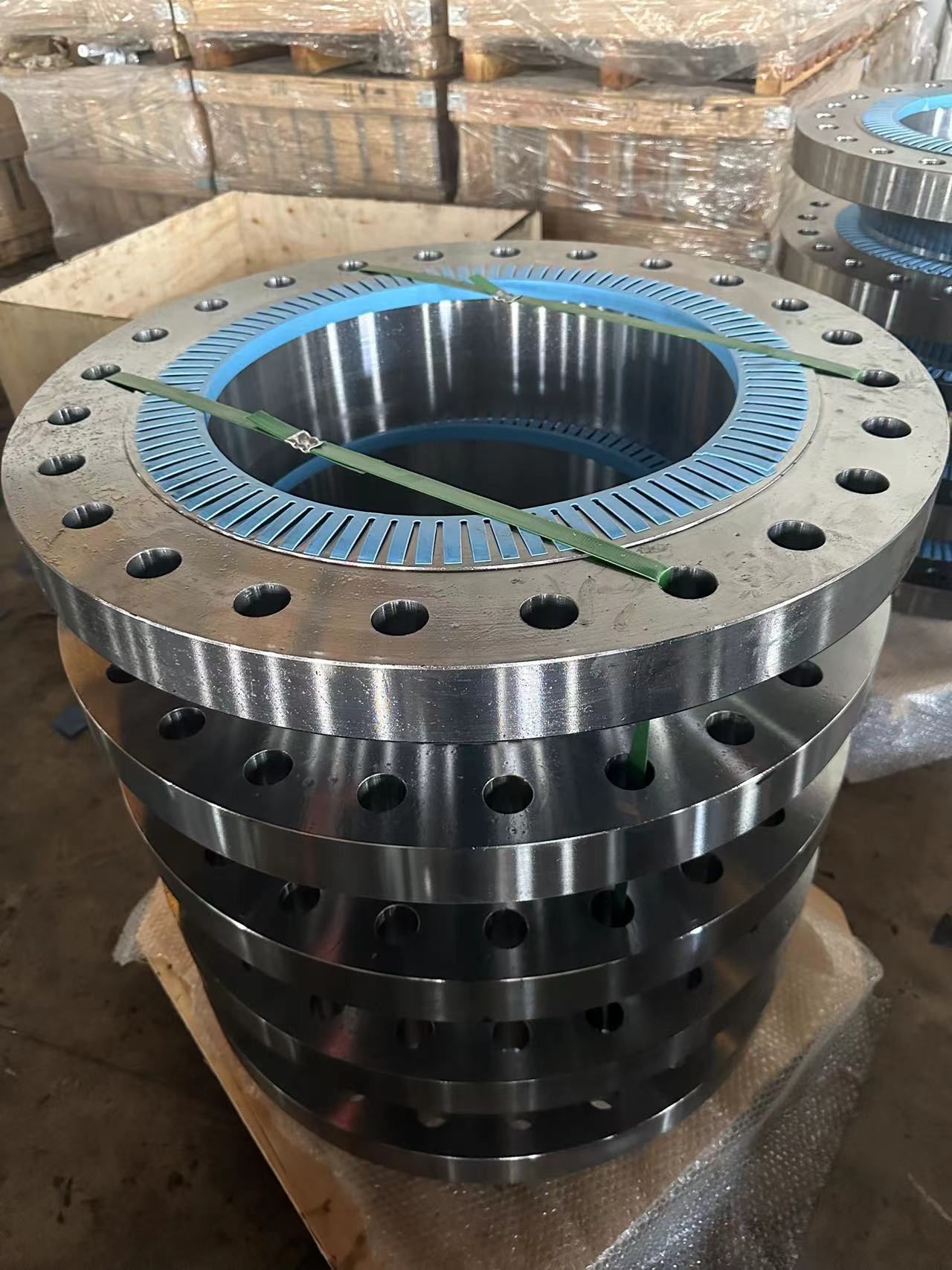
Flange, also known as flange disc or projection, is a disc-shaped connecting component, typically used in pairs.
Its basic function is to provide a detachable connection between pipes, valves, or equipment. Two flanges are fastened together with bolts, with a gasket placed in between. After tightening, the gasket deforms to fill the minute irregularities on the sealing surface, thereby achieving a tight connection. Flange connections are widely used in industrial piping systems due to their convenience and ability to withstand high pressures.
This product is a steel pipe flange, suitable for engineering scenarios in petroleum, chemical, electric power, construction water supply and drainage, shipbuilding, and other industries.
Part 2: Structural Types and Scope of Application (Objective Statement)
Flanges can be classified into multiple types according to the connection method. The following are several common types:
| Type | Structural Characteristics | Common Applicable Scenarios |
|---|---|---|
| Plate flat welding flange (PL) | Simple to manufacture, low cost, moderate rigidity | Pipelines with pressure rating ≤ 2.5MPa and relatively mild operating conditions |
| Slip-on welding flange (SO) | Relatively short neck, better rigidity than plate flat welding flange | Medium and low pressure pipelines, convenient for on-site installation |
| Weld-neck flange (WN) | Features a tall neck with gradual wall thickness transition matching the pipe wall | Pipelines with significant temperature or pressure fluctuations, high-temperature high-pressure and low-temperature conditions |
| Threaded flange (Th) | Internal threads in the flange bore, no welding required | Pipelines where welding is not permitted on-site or is inconvenient; recommended service temperature between -45°C and 260°C |
| Lapped joint flange (LJ/PJ) | Flange disc is rotatable, connected to the pipe via a lapped joint or flat welding ring | Connection solutions when pipe materials are expensive, and for applications requiring frequent disassembly |
| Blind flange (BL) | No central hole, used to seal the end of a pipeline | Pipeline blanking, can be removed at any time |
Note: The specific type selection should be determined comprehensively based on design pressure, temperature, and medium characteristics.
Part 3: Applicable Standards and Materials (Verifiable)
Common standard systems (can be interfaced as required):
National Standard (GB): GB/T 9112~9124 series
Chemical Industry Standard (HG): HG/T 20592 (European system), HG/T 20615 (American system)
Machinery Industry Standard (JB): JB/T 81~86 series
American Standard (ASME): ASME B16.5 (DN≤600), ASME B16.47 (large diameter)
German Standard (DIN), Japanese Standard (JIS), etc., can also be customized as required
Conventional material options (as actually supplied):
Carbon steel series: Q235, 20#, WCB
Stainless steel series: 304, 304L, 316, 316L, 321
Alloy steel series: Configured according to working condition requirements
Pressure rating coverage:
National Standard / European system: PN0.25 ~ PN42.0
American standard: Class150 ~ Class2500
Part 4: Core Components and Sealing Faces (Operating Principle Explanation)
A flange connection is a combined system consisting of a pair of flanges, a gasket, and a set of bolts and nuts.
Sealing face types (selected based on pressure and medium):
Raised face (RF): The most widely used sealing face type
Flat face (FF): Commonly used in low-pressure conditions
Male & female face (MFM) / Tongue & groove face (TG): Suitable for higher pressure or applications where the medium is flammable, explosive, or toxic
Ring joint face (RJ): Used for high-pressure pipelines and equipment
Part 5: Manufacturing Process Description
The manufacturing of flanges primarily involves two methods: forging and casting.
Forged flanges: Through forging, the internal structure of the steel becomes denser, providing better mechanical properties, suitable for higher pressure pipelines.
Cast flanges: Relatively lower manufacturing cost, capable of forming more complex shapes, commonly used in lower pressure pipelines.
The specific process to be adopted should be determined according to the design drawing requirements and operating conditions.