
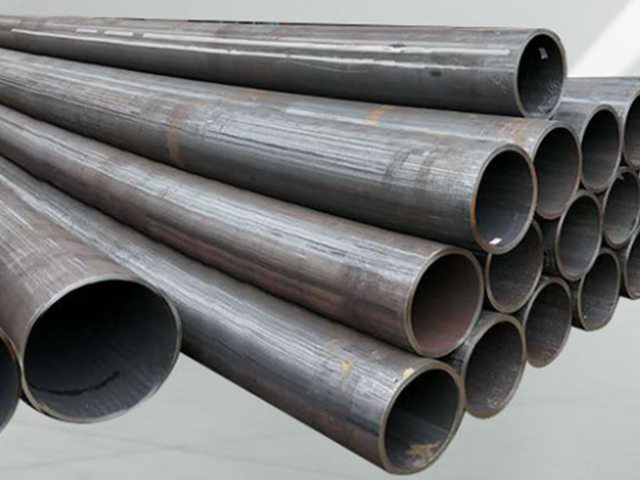
ERW steel pipe, full name Electric Resistance Welding straight seam high-frequency resistance welded pipe, is one of the widely used welded pipe categories at present, with a large number of production lines and a relatively high output share.
This product is manufactured using hot-rolled coil as the raw material and adopts the high-frequency resistance welding process. It differs from ordinary welded pipes in that the weld seam is formed by the melting and extrusion of the base metal of the steel strip itself, and the chemical composition of the weld zone is essentially consistent with that of the base metal. It is suitable for transportation pipelines for petroleum, natural gas, water, slurry, and other media, as well as engineering scenarios such as building structural supports and pile pipes.
Part 2: Process Characteristics (Objective Statement)
Forming and Welding
Processed through an automated continuous production line, involving slitting of the steel strip, forming, high-frequency welding, burr removal, sizing, and other procedures. The welding process does not add any filler material; instead, it utilizes the skin effect and proximity effect of high-frequency current to heat the edges of the pipe blank to the welding temperature and then squeezes them together to form the weld.
Geometric and Physical Seamlessness
Internal burr control: Through an internal burr removal system, the internal burr height can be controlled within the range of -0.2mm to 0.5mm.
Weld heat treatment: Medium-frequency induction heating equipment is used to perform heat treatment on the weld zone, refining the grain structure, eliminating welding stress, and improving the overall performance of the heat-affected zone.
Dimensional Accuracy
Using hot-rolled coil as the raw material, the wall thickness uniformity can be controlled within approximately ±0.2mm. Both ends are beveled and prepared according to relevant standards, and products are delivered in fixed lengths.
Part 3: Applicable Standards (Verifiable)
This product can be manufactured in accordance with the following standards (select according to the actual supply standards):
API 5L / API 5CT (for oil and natural gas transportation)
GB/T 9711 (steel pipes for the petroleum and natural gas industry)
GB/T 3091 (welded steel pipes for low-pressure fluid transportation)
ASTM A53 / ASTM A252 / JIS G3444 and other structural pipe standards
Steel grade coverage (partial list):
Carbon steel series: Q195, Q215, Q235, Q345
Line pipe steel series: GR.B, X42, X52, X60, X65, X70
Part 4: Application Scenario Reference
Long-distance oil and gas transmission pipelines and urban gas pipeline networks
Water supply and drainage engineering and slurry transportation
Building structural supports, bridges, and dock pile pipes
Load-bearing and pressure-bearing structural components and parts
Part 5: Quality Inspection (Process Description)
Inspection items carried out during the production process include (select according to actual configuration):
Chemical composition analysis and mechanical property testing (tensile, bending, flattening, impact, etc.)
Ultrasonic testing / Eddy current testing
Hydrostatic pressure testing
Appearance and dimensional inspection