
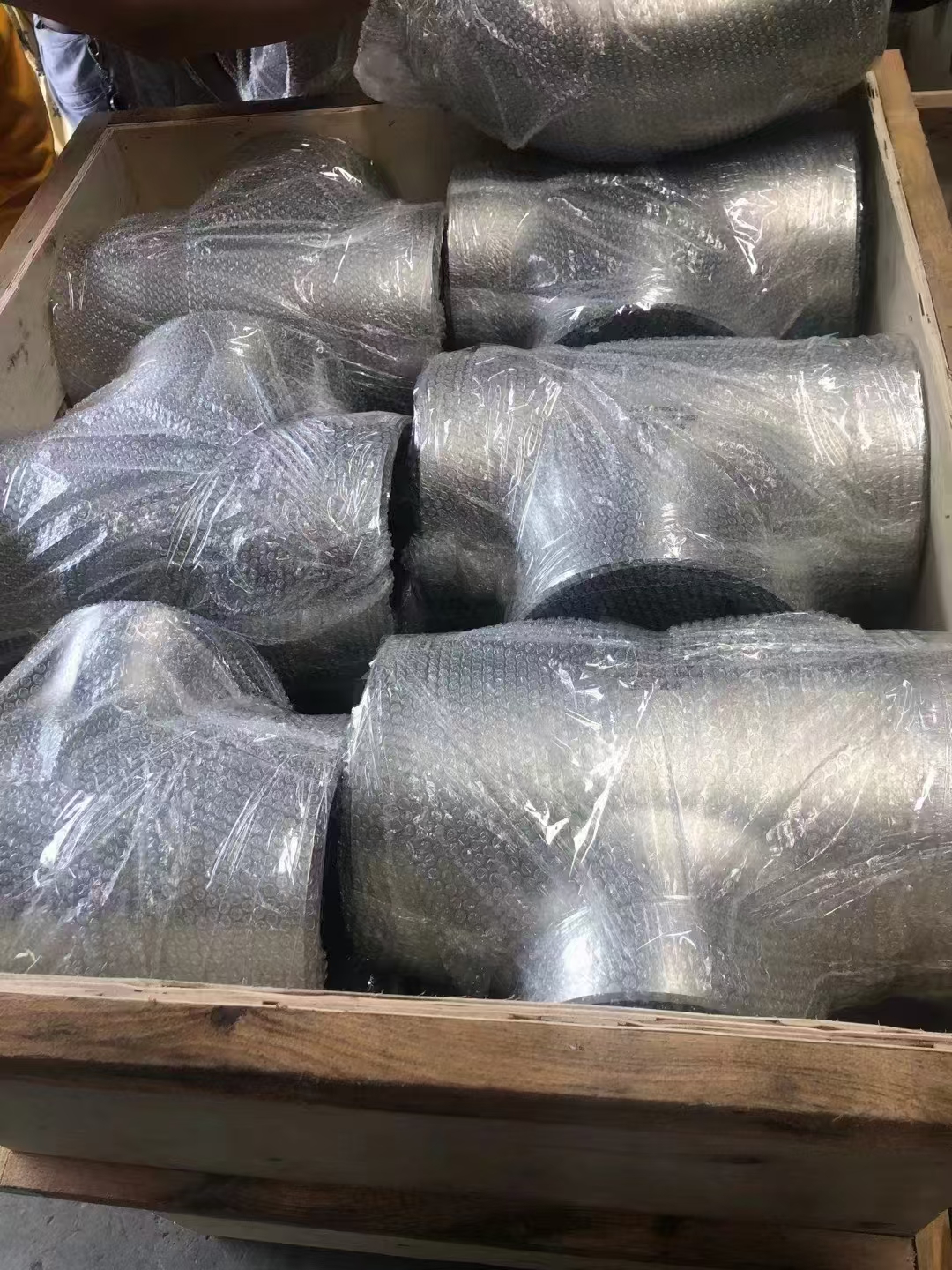
Tee, also known as a branch fitting, is a basic pipe fitting used in piping systems to achieve branch connections. Its structure features three openings, enabling one main pipeline to split flow in two directions, or two pipelines to merge into one main pipeline.
According to shape, it can be divided into T-shaped tee and Y-shaped tee. According to whether the branch pipe and the main pipe have the same diameter, it can be divided into straight tee (all three openings have the same diameter) and reducing tee (branch pipe diameter is smaller than the main pipe diameter). The products are widely used in piping systems in petroleum, chemical, natural gas, electric power, building water supply and drainage, and municipal engineering.
Part 2: Structural Classification (Objective Statement)
| Type | Structural Characteristics | Common Applications |
|---|---|---|
| Straight Tee | All three openings have the same nominal diameter | Same-diameter branching or merging on the main pipeline |
| Reducing Tee | Branch pipe diameter is smaller than the main pipe diameter | Main pipeline leads to a smaller-diameter branch pipe |
| T-shaped Tee | Three openings arranged in a T-shape, with branch pipe perpendicular to the main pipe | The most common branch connection form |
| Y-shaped Tee | Branch pipe connected at an oblique angle (typically 45°) to the main pipe | Scenarios requiring lower flow resistance during fluid merging or splitting |
Part 3: Applicable Standards and Materials (Verifiable)
Applicable standards (can be interfaced as required):
GB/T 12459: Steel butt-welded seamless pipe fittings (applicable to seamless tees, DN15~DN800)
GB/T 13401: Steel plate butt-welded pipe fittings (applicable to welded tees, large diameter specifications)
GB/T 14383: Forged socket-welding and threaded pipe fittings (applicable to small-diameter socket-welding tees)
ASME B16.9: American standard butt-welding pipe fittings (factory-made butt-welding fittings from forged or rolled materials)
02S403: National building standard design drawing collection for steel pipe fittings (covering dimensional specifications and weights of tees, crosses, and other fittings)
Conventional material options (as actually supplied):
Carbon steel series: 10#, 20#, Q235A, Q345 (16Mn), ASTM A234 WPB, etc.
Stainless steel series: 304, 304L, 316, 316L, ASTM A403, etc.
Alloy steel series: Configured according to working condition requirements
Specification range (reference values):
Outer diameter range: DN15 ~ DN1600 (2.5″ ~ 60″)
Wall thickness range: Sch5s ~ XXS (3mm ~ 60mm)
Part 4: Manufacturing Process Description
The main manufacturing methods for tees include the following:
Hydraulic bulging process
Liquid is injected into the tube blank, and the hydraulic press side cylinders simultaneously squeeze inward. The internal liquid pressure of the tube blank increases accordingly, and under the combined action, the metal material flows along the mold cavity to bulge out the branch pipe. Suitable for mass production of straight tees.
Hot pressing forming process
The tube blank, larger in diameter than the tee, is heated and flattened, with an opening made at the branch pipe position. It is placed into a forming mold and the branch pipe is drawn out through a punch. Suitable for large-diameter, thick-wall, and alloy steel or stainless steel tees.
Other processes
Pushing, forging, casting, etc., selected based on material, specification, and batch size.
Part 5: Connection Methods and Marking Instructions
Common connection forms:
Butt-welding (BW): Ends with bevels, connected by butt welding to the pipeline, suitable for high-pressure and large-diameter conditions
Socket-welding (SW): Ends with socket openings, suitable for small-diameter and relatively high-pressure conditions
Threaded connection (Th): Ends with internal threads, suitable for low-pressure and occasions where welding is inconvenient
Specification marking examples (for reference):
Straight tee: "T3" indicates a straight tee with an outer diameter of 3 inches
Reducing tee: "T4×4×3.5" indicates a reducing tee with a 4-inch main pipe and a 3.5-inch branch pipe
Part 6: Application Scenario Reference
Branch connections in long-distance oil and natural gas transmission pipelines
Process piping in chemical and refining plants
Urban water supply and drainage and gas pipeline networks
High-temperature and high-pressure steam pipelines in power plants
Building HVAC and fire protection piping systems