
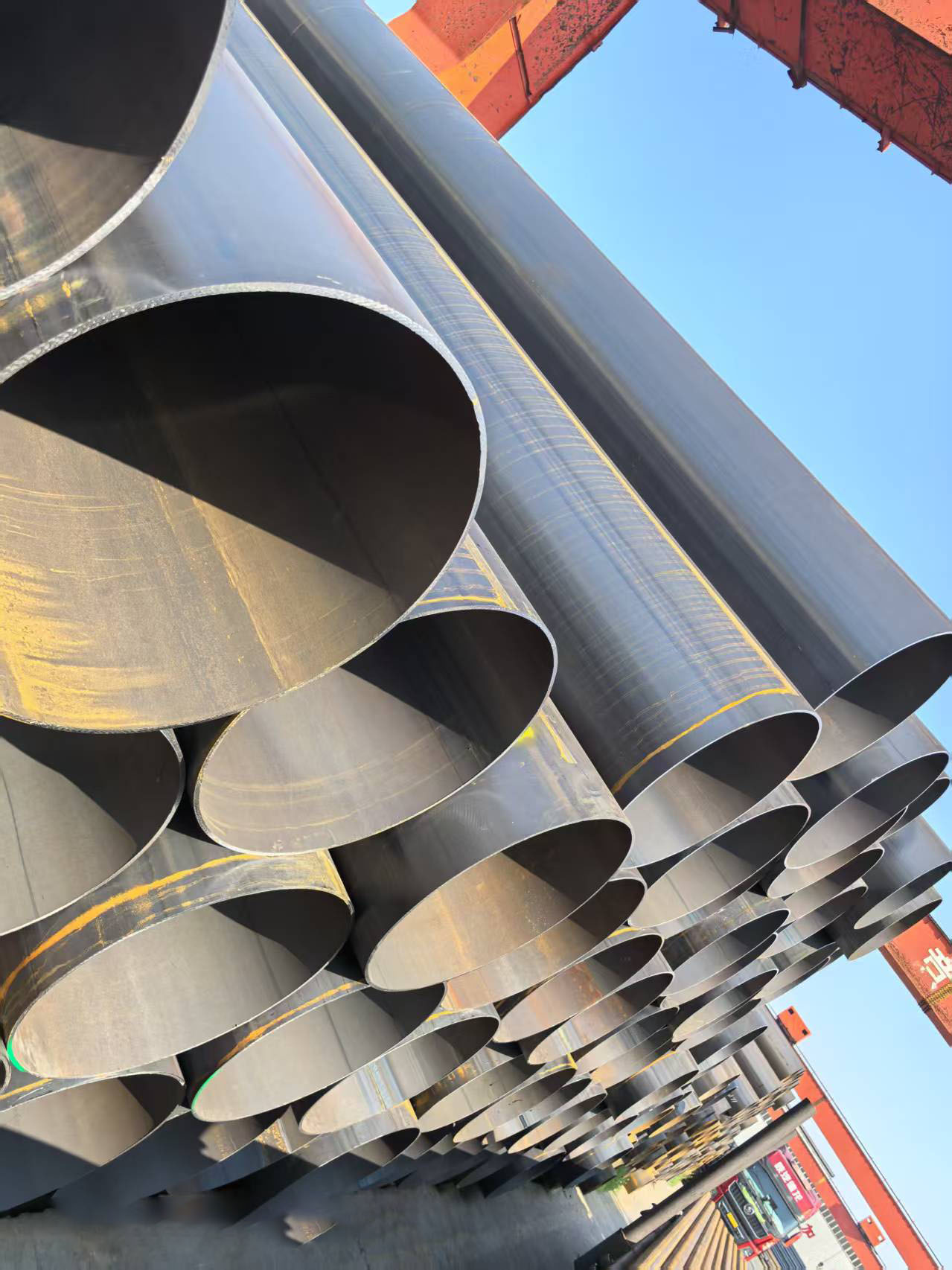
Longitudinally Submerged Arc Welded Pipe, abbreviated as LSAW, is a large-diameter straight seam welded pipe manufactured using a single steel plate or coiled plate as the raw material, formed through pressing (UOE / JCOE / bending), and welded by double-sided submerged arc welding.
Its weld seam runs longitudinally along the pipe body, resulting in a different stress state compared to spiral welds. LSAW pipes offer good weld quality stability in large-diameter and thick-wall specifications, and are widely used in long-distance oil and natural gas transmission pipelines, offshore engineering, urban pipeline networks, and large-scale steel structures.
Part 2: Forming Processes (Objective Statement)
The mainstream forming methods for LSAW steel pipes include:
| Forming Method | Process Characteristics | Applicable Specification Range |
|---|---|---|
| UOE forming | Steel plate is U-shaped pre-bent, O-shaped formed, then welded, followed by expanding and sizing; high dimensional accuracy | Large diameters, wide wall thickness range |
| JCOE forming | Steel plate is formed through multiple step-by-step bending (J-shape → C-shape → O-shape); relatively lower investment, good flexibility | Medium batch sizes, flexible specification switching |
| Bending forming | Press-formed multiple times using a large bending press; suitable for small batches and thick-wall specifications | Thick walls, special specifications |
Welding adopts double-sided submerged arc welding (SAW), with internal and external welds completed in one or multiple passes. The weld bead formation is stable and fusion depth is controllable.
Part 3: Product Characteristics (Objective Statement)
Weld quality: The double-sided submerged arc welding process offers deep penetration, high welding speed, and relatively stable weld quality
Dimensional accuracy: After expanding and sizing, the ovality and circumference deviation at pipe ends are well controlled, facilitating on-site butt welding
Wall thickness uniformity: Using steel plate as the raw material ensures good wall thickness consistency throughout the entire pipe, with no wall thickness reduction areas
Wide material coverage: Can produce pipes in line pipe steel, alloy steel, and stainless steel
Part 4: Applicable Standards and Materials (Verifiable)
Applicable standards (can be interfaced as required):
API SPEC 5L: American Petroleum Institute line pipe standard (PSL1 / PSL2)
GB/T 9711: Steel pipes for petroleum and natural gas industry transportation
GB/T 3091: Welded steel pipes for low-pressure fluid transportation
ASTM A252: American standard for welded steel pipe piles
EN 10219: European standard for structural welded pipes
SY/T 10037 (applicable for offshore engineering)
Common material grades (partial list):
Line pipe steel: GR.B, X42, X52, X60, X65, X70, X80
Carbon steel: Q235B, Q345B (Q355B)
Alloy steel and stainless steel can be configured according to working condition requirements
Part 5: Comparison with Spiral Steel Pipes (SAWH) (Objective Reference)
| Comparison Dimension | LSAW (Longitudinally Submerged Arc Welded Pipe) | SAWH (Spiral Submerged Arc Welded Pipe) |
|---|---|---|
| Weld form | Longitudinal straight weld | Spiral oblique weld |
| Raw material form | Single steel plate or coiled plate | Coiled plate (strip steel) |
| Diameter range | Large diameters (typically DN300 and above) | Wide diameter range |
| Weld length | Shorter (approximately equal to pipe length) | Longer (approximately 1.3~1.7 times the pipe length) |
| Wall thickness capability | Can produce thicker specifications | Wall thickness range limited by strip steel |
| Applicable scenarios | High-pressure long-distance pipelines, offshore engineering, structural applications | Medium and low-pressure water transmission, gas transmission, structural pile pipes |
Both have their respective advantages. Selection should be based on a comprehensive evaluation of design pressure, diameter, wall thickness, and economic factors.
Part 6: Application Scenario Reference
Onshore and offshore long-distance oil and gas transmission pipelines
Urban gas and district heating main pipeline networks
Pressure steel pipes for hydropower stations and water diversion projects
Large-scale steel structures, bridges, and dock pile pipes
Offshore platform jacket structures and risers